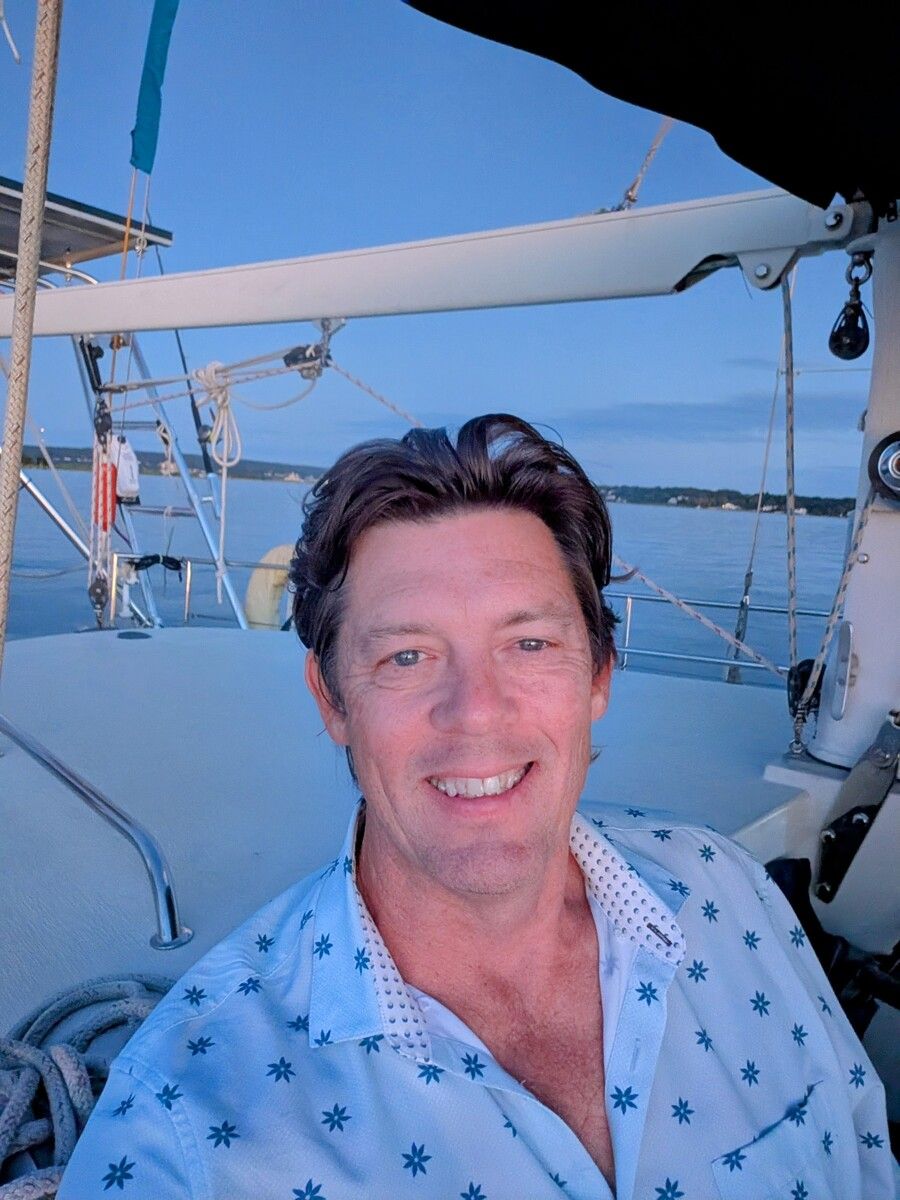
🌊The Sea State
Celtic Cross is tied up at Harbor Town Marina in Fort Lauderdale, settled into her slip after the run down from St. Augustine. This week she’s getting the planned lithium battery upgrades—the same project I’ve been preparing for over the past few months.
And I’m nowhere near her at the moment.
I’m writing this week’s letter from Paris, France, thousands of miles from the dock where I left her 48 hours ago. It’s a strange kind of contrast—one day I was watching the coastline slide past the rail, the next stepping into winter air and stone boulevards. The hum of a diesel replaced by the echo of the Métro, sea horizons swapped for rooftops and cathedral spires.
The boat is getting her upgrades.
I’m getting a temporary change of scene.
Scroll down to People of Tides below to find who I flew across the Atlantic and spent 48 hours in Paris to see.
📝Harbor Notes
This past week has been a string of short hops toward Fort Lauderdale— daylight runs, one inlet to the next.
I spent Sunday night in Fort Pierce, anchored across from the Coast Guard station (27°27.98’ N, 80°18.53’ W). The inlet is wide and forgiving. A bit of weekend buzz—jet skis, fishermen—but nothing that made the approach or anchoring difficult. One slow sweep through the anchorage checking out potential spots, a turn north of the channel, ten feet of water, and the hook was dropped.
The next morning it was a straightforward run to Lake Worth Inlet. The inlet is narrow but simple as long as you time it around commercial traffic. Big ships move in and out of the industrial basin, and you don’t want to be halfway through the inlet between the jetties when one appears. Inside, I anchored just south of Green 11 (26°46.5’ N, 80°20.4’ W)—plenty of room and solid holding. That night I listened to the hum of the machinery in the commercial port.
The final stretch to Fort Lauderdale had a little more personality. A squall came through—not long-lasting, just enough to stack up the waves, drop visibility, and make everything feel closer and louder for a while. One of the beautiful things about Celtic Cross is the ease of reefing. So I was in a good place when the winds pipped up to 40 knots briefly. Once the cell passed, the seas flattened out again and the coastline came into view.
As I made my way down the coast, a speedboat decided to cut closer to my stern than necessary and cut off the cedar plug I’d been trolling. Annoying, especially since it was the same one that caught that monster mahi-mahi last year off Chub Cay. Thankfully I’ve got a few spares.
By the time I reached the Fort Lauderdale inlet, the sky had cleared but the traffic had not. It’s a busy entrance—sports fishers blasting in and out, sail boats plugging along, smaller boats darting around. It’s the kind of inlet where you keep your head on a slow roll and assume no one else sees you until they prove otherwise.
Once inside, the water opens into a maze of docks, canals, and marinas. Loud, busy, and unmistakably Fort Lauderdale—boating turned all the way up. I made my way past the cruise ships and commercial terminals to Harbor Town Marina in the Dania Cut.
Then it hit me: I was back where it all started. Nearly three years ago, Celtic Cross was sitting in this same stretch of water the day I bought her. A lot of miles between then and now.
I made it to Harbor Town and turned toward my slip—only to find someone already in it. So, another round of musical boats. The Maz Ocean guys (the installers doing my battery upgrade) were great, though; one climbed aboard to help as I was maneuvering single-handed, and another met us at the new slip to catch lines. Tight, but it worked out perfectly.
This marina is phenomenal. Annapolis made an impression on me, but Fort Lauderdale feels like the full-tilt mecca of boating—extravagant, chaotic.
Song of the Crossing
After I tied up at the dock, I walked towards Federal Highway looking for dinner. I found a place called Grumpy Gary’s, tucked along a canal in Dania Beach. It’s a dockside dive with seafood baskets, mismatched chairs, and a crew of regulars. Gary himself, a former New York–New Jersey contractor who traded blueprints for barstools, has built a little world of his own here, complete with a lively Wednesday open mic.
I walked in expecting nothing more than some fried seafood. That lasted about half a minute.
After I found a stool at the bar, the open mic host, Peggy, approached me and asked if I played guitar. I said yes, and suddenly I was on the list. A little while later I found myself holding her guitar in front of a mic, starting into John Prine’s “Paradise.” A song I’ve known for a few years and used to perform with the Dale West Band in Austin, Texas.
Prine wrote Paradise in the early 1970s, a tribute to his father’s hometown in Muhlenberg County, Kentucky. The song is both a love letter and an elegy—remembering the place as it was, and mourning what strip mining had taken from it. Prine recorded it on his 1971 debut album, and since then it’s been covered by everyone from John Denver to the Everly Brothers to Jerry Garcia. But no matter who sings it, the song still carries Prine’s honesty and his way of making a simple melody feel like a whole story.
Halfway through the first chorus, Peggy stepped beside me and started harmonizing. Then Kenny—another regular and local musician—joined in too. No rehearsal, no plan, just voices falling naturally into place. It felt easy, unforced, and a little bit special. The kind of moment that reminds you how music has a way of creating its own community on the spot.
I think this song is really special. Check out our rendition below.
🎶 Melodies Aloft
In Paris I found a reminder that music doesn’t begin with sound—it begins with the people who build the tools that make sound possible. Saturday afternoon, I wandered through Rue de Rome, a street lined with luthiers whose craft goes back generations.
When Paris was reinvented in the mid-1800s under Baron Haussmann, the city didn’t just gain grand boulevards and sweeping views. Trades and craftsmen were intentionally concentrated into particular neighborhoods—bookbinders in one area, leatherworkers in another, instrument makers in yet another—so people could find the specialized work they needed in one place. Rue de Rome became the natural home for luthiers, especially with a Conservatory nearby. Students could walk their violins, violas, and cellos straight from a lesson to a workshop for adjustment or repair.
Walking down that street today, you can hear music without hearing a note. Through the windows, luthiers bend maple, carve spruce, and fit tiny pieces of wood that will one day shape someone’s sound. I stood outside one shop long enough to watch a craftsman coax the curve of a cello’s side into place. The work was quiet, slow, and deliberate—nothing flashy, nothing hurried. Just the simple act of bringing an instrument into the world.
It’s easy to celebrate the performers, the songs, the voices. But today's visit reminded me that music also comes from the people who spend their lives shaping the tools themselves. Their work disappears into someone else’s hand

Luthier at work on Rue de Rome

Luthier shops along Rue de Rome