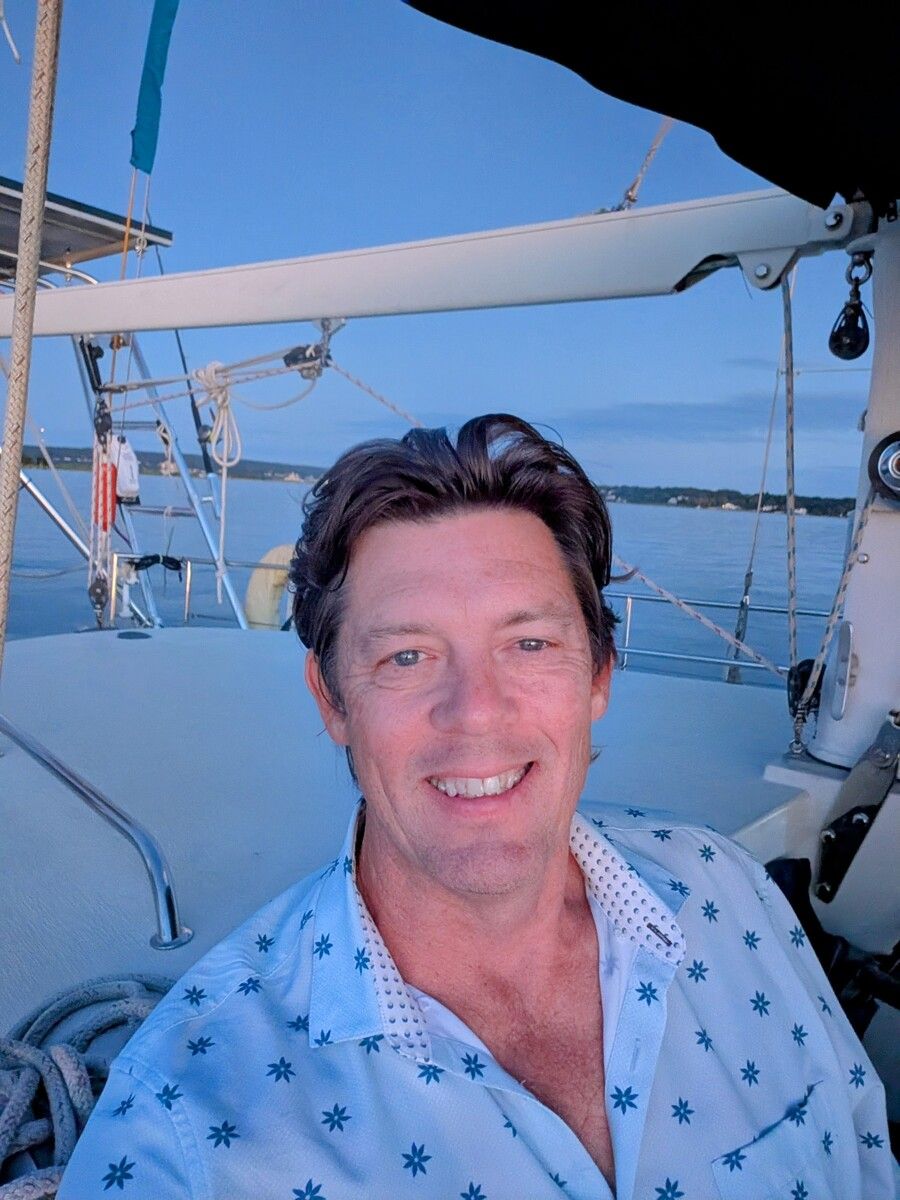
🌊The Sea State
Two weeks ago, on Thursday morning I pulled anchor at McNutt’s Island and left Shelburne, Nova Scotia, bound across the Gulf of Maine for the United States.
Almost immediately after leaving the anchorage, Celtic Cross disappeared into the fog.
For roughly the next 30 hours, that was my world. I didn’t see land again until Saturday morning, when the tip of Cape Cod finally appeared on the horizon. As I worked farther offshore and toward the middle of the Gulf of Maine, the temperature rose and the fog eventually lifted, giving me clear skies for the rest of the crossing.
This was another two-night, single-handed passage, which meant returning to the routine I’ve developed offshore: sleep for about 45 minutes, wake up, check the radar and AIS, then make a visual sweep of the horizon before going back below for another short nap. Repeat that throughout the night.
The passage itself has been pretty comfortable. The biggest problem was simply a lack of wind. For much of the crossing I had to rely on the engine, but late Friday night the wind finally began to fill in. I rolled out the genoa and set the mainsail out over the opposite rail, sailing wing-on-wing toward Cape Cod.
As the wind built overnight, I was finally able to shut down the engine and let Celtic Cross do what she came here to do. There’s something especially satisfying about the moment the engine goes quiet offshore and the sounds of the boat and the water take over again.
Saturday morning, Cape Cod came into view.
And now, as I write this, I can see the Pilgrim Monument rising above Provincetown. I have about two hours left before I round the corner into the harbor and drop anchor.
There’s a nice symmetry to arriving here. Provincetown is where I departed in July with four friends aboard, across this same stretch of water for Nova Scotia. This morning I’m returning across it alone.
Same harbor. Same boat. Same Gulf of Maine.
A very different passage.
📝Harbor Notes
As this newsletter goes out, I’m anchored in Onset Bay on the west end of the Cape Cod Canal. Saturday morning I left Provincetown after staying put for a week after my passage from Nova Scotia.
Most people associate the Pilgrims with Plymouth and Plymouth Rock, but their first landfall in New England was actually here in Provincetown in 1620. They spent several weeks exploring Cape Cod before eventually moving across the bay to Plymouth.
Provincetown has always struck me as a town with a strong independent streak. Over the years it has attracted artists, writers, fishermen, travelers, and people who simply wanted a place where they could live their lives on their own terms. That history has given P-Town a personality unlike just about anywhere else on Cape Cod.
Anthony Bourdain is one of the names connected to that history. Long before he became famous, he spent time here working in restaurant kitchens and beginning to figure out what he wanted to do with his life. With the renewed attention around his story lately, that connection to Provincetown has been getting some attention again.
For a cruising sailor, it’s also just a great place to stop.
The harbor provides a well-protected anchorage, and there’s a dinghy dock that puts you within walking distance of the shops, restaurants and bars downtown. There are whale-watching boats and other tour boats coming and going, but their routes generally take them straight out of the harbor rather than through the anchorage, so things stay surprisingly quiet aboard Celtic Cross.
The Pilgrim Monument towers over everything and is visible from well offshore. I climbed to the top during my first stay here last year, and after spending two nights crossing the Gulf of Maine, seeing it appear on the horizon Saturday morning felt a little different this time. It wasn't something I needed to climb again. It was a landmark telling me I was almost home.

Pilgrim Monument
I’ve really enjoyed my visits to P-Town over the years, and I expect this one will be no different. I’ll spend a few days here recovering from the crossing, reprovisioning and restocking Celtic Cross, and taking on water and fuel.
Then I’ll pull the anchor again and start working my way south toward Block Island.