🌊The Sea State
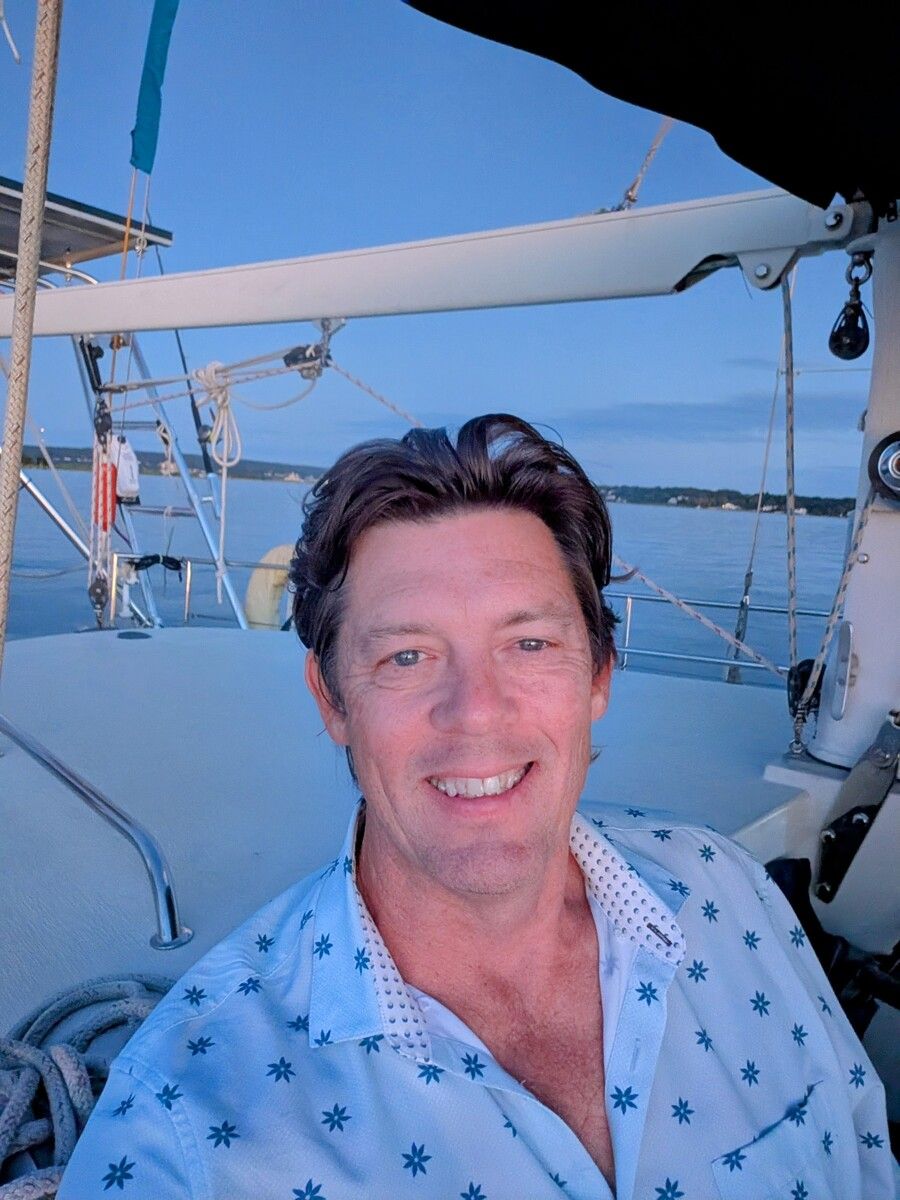
Tuesday morning I lifted anchor in Thompson Bay/Salt Pond, Long Island and pointed back toward Georgetown via Exuma Sound. There were a few things I wanted to take care of over there this week—laundry being one of them, but more immediately before I could do laundry, water. I was getting low, and the water in Thompson Bay had taken on a silty look that I didn’t love. Between the shallow bottom and the blow over the weekend, it had all been stirred up pretty good. You can definitely see the difference. Georgetown’s harbor water, by comparison, was clearer, clean enough to comfortably run the watermaker and top off the tanks.
Another reason for heading out into the sound instead of ducking back through the reefs was fishing. Deeper water meant a chance to put a line out, and I’d just shared the last of my wahoo Monday night at a post-storm survival party. The freezer was officially empty of fish again.
The forecast looked solid—about 15 to 20 knots, dead downwind—and this boat really shines in that condition. With both the headsail and the ballooner out (what we Amelian’s call our asymmetrical spinnaker), she’ll just lope along. But for a 20-mile run, rigging the ballooner solo didn’t make much sense. It’s a half-hour job on a good day, and I didn’t need the extra canvas.
So I ran wing-on-wing with the mainsail, traveler eased all the way over. Simple, effective, and steady. Seas were around three feet, spaced about eight seconds apart—comfortable. Downwind sailing always brings a bit of roll, but the wing-on-wing setup kept things settled and efficient, and the miles clicked off without drama.
By early Friday morning the winds picked up as another forecasted cold front moved through. I saw gusts touching 30 knots, but I was happy with where I was anchored. I’m sitting right on the edge of the channel, a little farther south than I’ve normally been here in Georgetown, but it’s a good spot. Plenty of room to swing, good holding, and no surprises. It blew steadily and with some authority for a while, but it’s expected to ease as the day goes on. For now, it’s just a matter of staying put and letting it pass.
📝Harbor Notes
Da Sand Bar on Stocking Island isn’t fancy. It’s barely even finished. The place looks like it was built out of spare lumber and good intentions, but that’s kind of the point. Its most prominent feature isn’t the bar at all—it’s the pool table sitting right out front, open to the breeze, sand underfoot, and whatever crowd happens to drift in that day.

Da Sand Bar Pool Table
Over the past month and a half, I’ve become something of a regular there, playing pool with whoever’s around. Local captains. Tour guides bring their charters there to experience it. Sailors fresh on anchor. Tourists who didn’t expect to end up in a beach shack competing for bragging rights. On Sundays, they run a pool tournament. I’ve won it once. I’ve lost it four times. One of these days, I’m hoping to tip that ratio back in my favor.
It’s been a great place to spend an afternoon and get to know people who actually work these waters—guys and gals who bring boats and people through here every day and know this place in a way you only do when it’s your backyard. Just a table, a cue, and whoever’s up next.
Pool is a funny game, though. In a lot of ways, I think it’s like golf. The more you play, the more you care, the more you start thinking about mechanics and angles and outcomes—and somehow, the worse you get. When I took about a week off while I was over on Long Island and came back this week, my game felt crisper. Sharper. Less forced. That gives me some optimism heading into Sunday.
The buy-in is twenty bucks, and the pot usually runs anywhere from $140 up to $200 or $220, depending on the crowd. Not a lot of money, but enough to keep things interesting. This weekend should be a good one too—it’s Super Bowl Sunday, and I hear they’re running a few specials. That usually brings out a mix of locals and visitors, which makes the whole thing even better.
At the end of the day, pool at Da Sand Bar is less about winning or losing and more about being there. I have to pinch myself occasionally when I look out past the table see the sun setting over Exuma Island. It can sure be surreal at times.
🎶 Melodies Aloft
“Rake and Scrape” music is everywhere here, even when it’s not front and center. You’ll hear it drifting out of a bar, find it playing in a shop over the radio, or riding the breeze from somewhere you can’t quite see. The rhythm is unmistakable, but what really defines it is that scraping sound working underneath everything else—raw, percussive, and almost industrial in the best way.
Its roots can be traced back to the Turks and Caicos, where enslaved Africans blended West African rhythms with European instruments and whatever household or work tools were available. As people migrated, especially to Cat Island, the sound came with them and evolved into something distinctly Bahamian.
When contrasted with Junkanoo, which people often recognize first when they think of Bahamian music. Junkanoo is big, loud, and outward-facing—goatskin drums, cowbells, horns, whistles, elaborate costumes, and entire streets moving together at once. It’s performance, procession, and spectacle. It fills the space.
Rake and Scrape, by comparison, is more intimate. It’s dance music meant for close quarters—small rooms, packed bars, and backyards. Where Junkanoo announces itself, rake and scrape settles in and takes over from the inside. You don’t watch it so much as you find yourself moving to it before you realize what’s happening.
What has fascinated me is how physical the sound is. I’ve been lucky enough to record a few of the different ways bands here create that signature sound. One uses something that looks a lot like a carpenter’s saw, held upright and scraped with a screwdriver or metal rod. Another uses a round piece of metal—almost like a circular plate—with raised indentations, scraped rapidly with what looks like a pick. Same idea, different texture. And sometimes there’s no dedicated scraping instrument at all—just fast, relentless cymbal work driving the groove hard enough to fill that role.
It’s music built from whatever’s at hand. Practical. Rhythmic. Unpolished. A sound shaped by migration, necessity, and celebration—and one that fits surprisingly well with the creak of dock lines, the slap of halyards, and the steady rhythm of life afloat here in the Bahamas.
People of the Tides
A few weeks ago, I found myself craving queen conch on the grill. Unfortunately, I didn’t have any on board, which meant a choice: buy some, or go find it myself.
Last year I had decent luck diving for conch. Up in the Berry Islands, I once found five in a single afternoon. Down here in Elizabeth Harbour, though, it’s a different story. You’re not permitted to dive for conch inside the harbor, which means heading outside and putting in a little more effort.
There is, of course, another option.
On Chat and Chill beach, Ronaldo runs the conch salad stand. If you’ve spent any time here, you already know him—or at least you’ve seen him. I dinghied in and asked what it would cost to buy a conch still in its shell. The price wasn’t what I’d hoped for, but I understood immediately. He’s a businessman. This is his livelihood.
He smiled and told me it would be much more economical if I went and dove for conch myself.
Naturally, I asked where I should go.
Blank stare.
I tried again. “At least tell me if I should go north or south?”, I asked.
“Yes,” he said, smiling again.
Fair enough. He’s not about to give up his source, and I wouldn’t expect him to. He’s protecting his stock, his knowledge, his edge. That’s part of how you run a successful business.
So I ventured off on my own, heading north. My method hasn’t changed much—snorkeling along the sandy stretches, towing the dinghy behind me, eyes scanning for shells half-buried in the bottom. After about thirty minutes, I found one.

That afternoon, I brought it back to Da Sandbar where they’ve got a grill. I cracked it, cleaned it, sliced it up, and threw it in some aluminum foil over the fire with lemon pepper and a little “Slap Ya Mama” seasoning. Simple. Perfect.
Since then, I’ve seen Ronaldo around more than a few times, usually motoring by in his small white runabout, often loaded with conch. He always says hello. Always smiles. Always seems genuinely glad to see you. He’s an institution here—one of those people who quietly is the place.
If you ever find yourself down this way and want good conch salad, give Ronaldo on Chat and Chill Beach a visit.

📕Log Book
I hit a small setback this week with the engine room hatch—the door in the cockpit sole that gives access below. It’s supported by two gas piston struts that normally take over once the hatch gets past a certain point, engaging and holding it open while you work. Or at least, that’s how they’re supposed to work.
Both struts had failed. The oil had leaked out past the seals, leaving them useless. I called the company that manufactures the original struts to ask about replacements, and they requested a few photos of what I had installed. That’s when things got interesting.
They immediately pointed out corrosion on the rod—the part of the strut that slides in and out of the cylinder past the seal. That corrosion, they explained, acts like sandpaper. Every time the rod moves through the seal, it cuts just a little more material away until eventually the seal gives up and the oil escapes.

Welded end and corrosion on strut shaft
They also noticed that the end fittings had been welded on. Their struts use threaded ends, not welded ones, and they carry a corrosion resistance warranty. Seeing rust on the rod—and welded fittings—was a surprise to them. The implication was pretty clear: these weren’t their struts at all, but knockoffs installed at some point along the line.
Either way, the outcome was the same. I ordered a new set for the engine compartment hatch. Once they’re in, I won’t have to tie the door off every time I’m working in the engine room.
I also did a bit of maintenance Saturday that felt worth documenting. Last spring, while leaving a dock in Norfolk, Virginia, my bow thruster failed to deploy—exactly the moment you really want it working, with the wind pushing me back toward the dock. I tried to muscle off with engine and a little manual help, but the wind won. As I slid forward along the dock, my solar arch caught a piling and did some minor damage to the deck.
The root cause turned out to be the bow thruster control board—the small printed circuit board that senses deployment below the hull and handles the port and starboard commands from the helm. Two capacitors had broken off the board. Fortunately, the previous owner had outfitted the boat for long-distance cruising and carried a spare control board. I swapped it in once I reached my destination, and the thruster was back in service.
Recently, while I was in Fort Lauderdale, I tracked down the correct capacitors and had an electronics tech solder them back onto the original board. Saturday afternoon, I put that repaired board back into service to confirm it worked properly.

Replacing Bow Thruster Control Board
It’s good to have backups. It’s better to know they actually work. By putting the original board back in and taking the spare out of service, I now know I’m carrying a tested, functional spare if I ever need it. One of those lessons boats teach over and over: redundancy only matters if you’ve verified it.
On another satisfying note, I finally made some progress on the dinghy chaps. I got all the material cut. There are five separate sections that need to be sewn together to make the full cover, which protects the Hypalon inflatable tubes from sun and wear. That project had been stalled for a while, but it’s officially moving again—slowly, but in the right direction.
🧭My Bearings
Being back in Georgetown has let me settle into a rhythm again. Pool games here and there during the week up at Da Sand Bar. Friday night dinners at the Fish Fry. Although this Friday was a short one—it’s been unseasonably chilly down here (ok, 60s is not really cold), and after dinner and a few conversations with friends I’ve gotten to know over the past few weeks, I headed back to the boat before the cold really set in.
That quieter pace has left some room to think, and over the last week the picture of the year ahead has started to come into focus.
I’ll be leaving the Bahamas in early April, with a stop in Florida to see family and friends. From there, I’ll head north to Norfolk, where I’ve got some practical work planned—upgrading the solar panels and doing a bit of deck reinforcement to better support the solar arch and the added weight. Necessary work. Foundational work.
After that, I’ll point the bow east toward Bermuda. Bermuda was the first landfall I ever made after setting off on a training passage with John Kretschmer, and returning there feels fitting. A kind of full circle moment. I’m looking forward to seeing the island again and using it as the jumping-off point for what comes next.
From Bermuda, the plan is to sail to the Azores and stage there. I’ve got friends who want to sail the final leg to Ireland with me, which means I’ll be looking for crew for the first two legs to Bermuda and the Azores—a puzzle I’ll need to start solving in the coming months. The goal is to arrive in Ireland by July.
Once there, the idea is to slow things down a bit and explore: the British Isles, including Scotland, Ireland and the Hebrides, then work south through England, France, Spain, and Portugal, before making my way back down to the Canary Islands for the winter.
It’s starting to feel real now. I know it might seem like things have been stalled lately, with so much time spent in Georgetown, but this has really been a place to live for a while—to prepare, to fix things, to think. Not every week is going to be dramatic or headline-worthy, but I appreciate everyone sticking with me through the quieter stretches. There’s a lot ahead, and I’m looking forward to sharing more of it as the journey unfolds.
