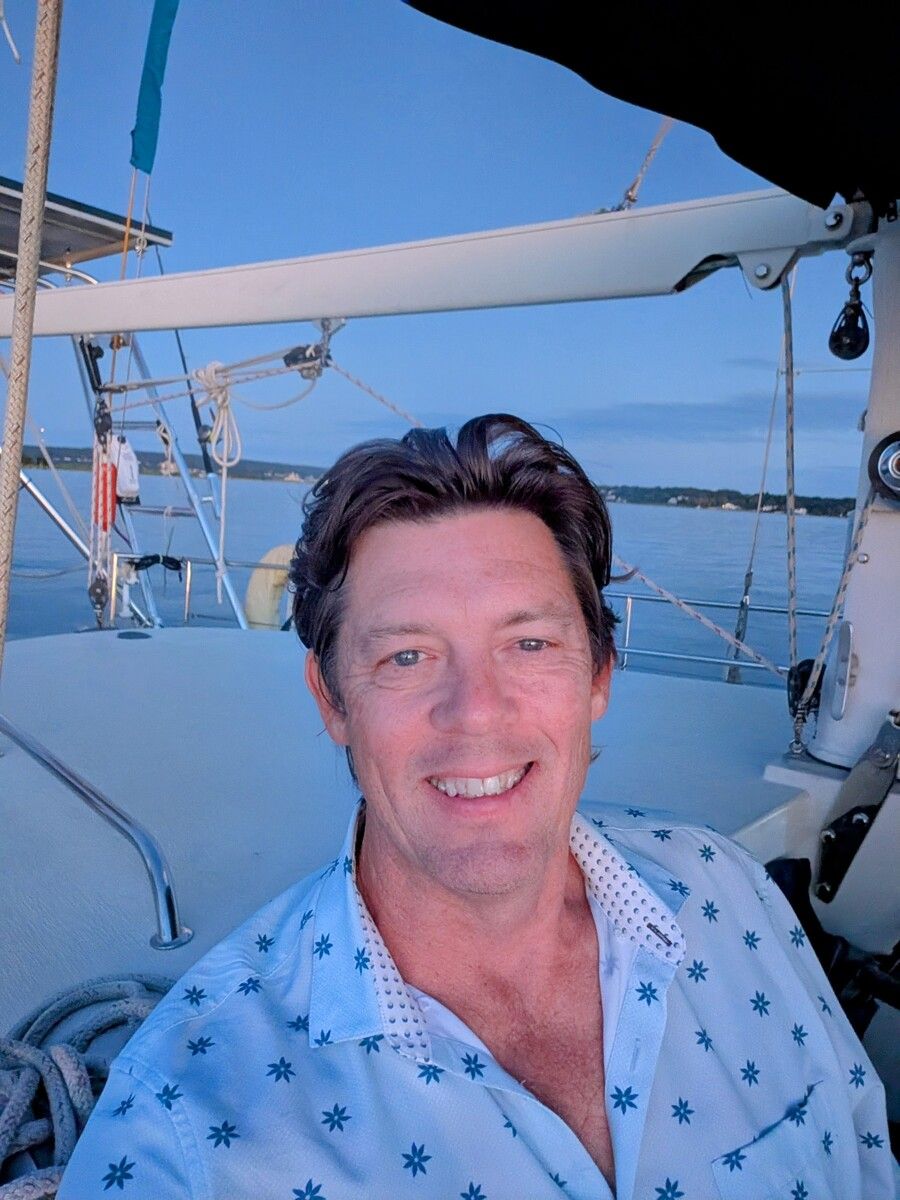
🌊The Sea State
Tuesday, January 27
The plan this morning was simple: move Celtic Cross from Georgetown down to Long Island, aiming for Thompson’s Bay. A local captain I’d spoken with recently recommended it—not because there’s much there (there isn’t), but because it’s different. A grocery store, a couple of restaurants, a new anchorage, and some beautiful scenery. That’s enough.
The forecast called for a front to move through early. When I woke around six, Georgetown Harbor was completely calm—not a ripple anywhere. Within the hour, though, the wind filled in. By the time I pulled anchor and headed south past the end of Stocking Island and out into Exuma Sound, it was already blowing 15 to 16 knots.
Seas built quickly but stayed manageable—two to three feet, close together, a little choppy. As the wind climbed into the low twenties, it set up one of the best sails I’ve had in a while: a clean beam reach. The seas on port stern, the boat felt balanced, and everything just worked. I even saw nine knots a couple of times.
A catamaran that had left Georgetown ahead of me arrived about 20 minutes after me. That always feels good.
Update (Early Sunday Morning)
Around 2 a.m. Sunday morning, the winds associated with the cold front moving into the area had arrived. I’d turned in early, knowing the overnight hours were when things were expected to pick up, and they came in right on schedule.
By the time I was fully awake, the wind was blowing a steady 32 to 33 knots, which was about the peak I saw. The boat rode it well. The anchor was holding, and everything on deck behaved the way it should. Earlier in the evening, I’d taken down part of the bimini to keep it from getting worked over and pulled the courtesy flag so it wouldn’t shred itself in the dark.
They’d been calling for possible 40-knot winds, but so far it doesn’t look like we’re going to see that. Once I was satisfied everything was settled, I dozed back off—eventually. Around 6 a.m., I woke up and the wind was still blowing around 30 knots, but everything was good. We were still well within the anchor alarm radius.
📝Harbor Notes
Thompson Bay, Long Island, Bahamas
By about 4:30 in the afternoon on Tuesday, the wind finally started to ease enough that I felt comfortable getting the dinghy off the deck. I’m usually reluctant to do that much above 15–17 knots—once the dinghy on the end of a halyard catches in a breeze, it can turn into something you’re no longer fully in control of. But things were settling down, and I had a mission ashore.
I’d heard there was a grocery store here that was surprisingly well stocked for being so remote. That turned out to be true—better than Georgetown, actually. I’ve been hunting for bread flour to keep my sourdough experiment alive, and Thompson Bay’s Hillside Grocery delivered.
On the way in, I aimed for what I thought was the dock closest to town, but I stopped to ask another boat in the anchorage if that was the case. They told me it had taken hurricane damage and wasn’t really safe anymore. Instead, they pointed me farther down to the government dock—which added a bit of distance to the walk, but seemed like the smart move.
I tied up at the concrete government dock alongside a couple of fishing boats and started walking. It ended up being a solid mile and a halfs to the store. The road was strikingly quiet—the entire walk in, I think only two cars passed me. That alone told me this was a very different place than Georgetown.

/
After stocking up on bread flour and some fruit, I stopped at Sou Side, a local bar and grill, and wound up chatting with a couple of guys there. One was originally from Maine—sailed down here about 30 years ago and never left. The other was the proprietor and a local fisherman. With the forecast for the weekend looking like it did, I appreciated his reassurance that Thompson Bay was a good place to be in a gale out of the North to Northwest. We also talked about the island itself—how Long Island once had around 7,000 residents and now sits closer to 3,000. Still a big island. Lots of space. Lots of quiet.
After a couple of beers, I decided to start heading back. Rain was clearly building, and sure enough it had already swept through the bay. Unfortunately, I’d left the hatches open, so I knew I had a bit of cleanup waiting for me aboard.
On the walk back, I threw my thumb out more out of curiosity than expectation. Given how few cars I’d seen all afternoon, I wasn’t especially optimistic. But a truck slowed, pulled over, and asked how far I was going. I told him to the government dock and climbed into the back and was back at the dock in a couple of minutes.
Back aboard, I confirmed what I already knew: the boat had gotten a little wet inside. Nothing serious—just a reminder to close the hatches when you leave.
Postscript:
Later in the week, I did end up using the hurricane-damaged dock I’d been warned about. All of the horizontal slats were gone. After tying up and climbing out via a ladder, moving down the dock became a careful balancing act—placing each step deliberately, no distractions, no hurry. It wasn’t something you’d call comfortable, but it shaved a significant amount of walking off the trip ashore, and I decided the trade-off was worth it. Another quiet reminder that cruising is often just a series of small risk calculations.

S
Stark Differences
This won’t be a weekly section. It’ll show up when there’s something worth noticing—something that feels different enough from the way I used to live that it deserves a few lines. I want you, my virtual shipmates, to be aware of what I see as a slow transformation.
One of the bigger changes I’ve noticed on this trip is how much I’ve slowed down—and how many things I’ve quietly let fall away. Not dramatically. They just stopped making sense.
A good example is how I spend idle time. Before, it was easy to reach for my phone and disappear into an endless stream of 30-second clips. Small hits of novelty. Cheap dopamine. Lots of motion, not much movement. It kept my hands busy and my nervous system oddly restless.
Out here, that habit has mostly been replaced by small boat projects. Mundane things. Pulling a few stainless screws, cleaning the threads, adding a dab of Tef-Gel, and reinstalling them so they don’t corrode themselves into place. Nothing exciting. Nothing that would ever make a highlight reel. But when I’m doing that kind of work, my mind settles. My attention narrows in a good way. The boat gets a little better, and so do I.
Another example is my sourdough bread making. Something a lot of cruisers do.
It really takes time. You can’t rush it. You can’t decide at four in the afternoon that you want fresh bread by dinner—at least not good bread. You have to plan for it. Sometimes it takes two or three days just to get the starter into a state where it’s ready to be used.
I try to keep the right ingredients aboard, and I have a starter that I probably mistreat by most standards. I don’t always feed it on schedule. Sometimes I leave it out longer than I should. I like to think that adds character—maybe even a little resilience. I’ve named it Diesel, partly because it just keeps going, and partly because when I let the dough rise, I usually set it on top of the diesel engine in the engine room. It’s normally warm down there—usually around 75 to 80 degrees—and it turns out to be a pretty reliable place for bread to take its time becoming bread.
It’s a slow, methodical process. One you can’t just drop everything and do. You have to think ahead. You have to wait. And then you wait a little more.
I’m pretty sure pre-sailing Andy wouldn’t have taken the time for any of this. He would have optimized it away. Found a shortcut. Grabbed something faster. But somewhere along the way, I’ve started to enjoy these slower rhythms—the ones that don’t reward urgency, but do reward patience.

Diesel rising on the engine block
🎶 Song of the Crossing
This week’s song has been following me around for few weeks.
“Way Over Yonder in the Minor Key” was written by Billy Bragg and recorded with Wilco as part of the Mermaid Avenue sessions. That project came about when the Woody Guthrie family invited Bragg and Wilco to set music to hundreds of unused lyrics Guthrie had left behind.
However, this song isn’t one of those.
“Way Over Yonder in the Minor Key” is a Billy Bragg original, written alongside the Guthrie material but very much its own thing. In a way, it feels like Bragg stepping slightly out of the shadow of that project and writing about the act of believing in yourself.
The song is essentially about a narrator who thinks he’s meant to be something greater—maybe a great singer, maybe just someone who finally lives up to the version of himself he hears in his own head. There’s confidence in that belief, but it’s not swagger. The “minor key” is important. It keeps the song grounded, a little self-aware, maybe even a little unsure.
It’s not about where I am or what I’m doing right now. It’s about that familiar feeling of knowing—or hoping—that there’s more in you than you’ve fully figured out how to express yet. That you’re still working your way toward the voice you think you’re supposed to have.
I recorded this one Saturday afternoon and paired it with photos from a excursion up to the north end of Long Island. No deeper connection than that. The song and the images just seemed comfortable together.
At times, Song of the Crossing really is about a passage. This time, it’s more about the belief that you’re still becoming who you’re meant to be—even if you’re not quite there yet.
People of the Tides
Lawrence Part II
Last weekend, Lawrence called and asked what I was up to. If I didn’t have anything pressing, he said, I should come into Georgetown and he’d take me for a drive. A little tour of the island.
I had a few boat chores to get through first, but by around noon I met him at the dock and we headed south.
The first place he took me was a piece of property he’s been working on—land he saw something in long before it looked like much of anything. At one point it was just thick, overgrown bush. He cleared it himself, piece by piece. Now there’s a home taking shape there, with open views east and west. From one side you can see the Exuma Bank, from the other the Exuma Sound. It’s a striking spot, but what stayed with me more than the view was the patience behind it—the willingness to imagine what something could be and then slowly make it real.
We kept driving, through Rolletown and across the ferry bridge. Not far beyond that, he pulled over and showed me the foundation of the house his mother was born in. The plan is to restore it—not to live in, but as a way of preserving his family’s history on the island. More memory than project. Something meant to last.
From there, we continued farther south. I’d mentioned the Tropic of Cancer in a previous issue, and Lawrence took me all the way there—to the bar, and then down to the beach where that line cuts across the island. We walked for a bit, talking, letting the place speak for itself.

Mostly, though, the day was just that: driving around, talking, stopping when it felt right. No real plan beyond being out and seeing things together. Easy hospitality.
At some point it hit me that it was the first time I’d been in a car in about a month and a half. Seeing the island roll by at road speed instead of hull speed felt almost strange. Familiar and unfamiliar at the same time.
It was a really good afternoon.
📕Log Book
Lately, I’ve been running the generator more than I’d like to top off the lithium batteries. I simply don’t have enough solar yet—something I’m planning to fix later this spring—but the tradeoff is more hours on the generator, and more wear that comes with it.
This morning I checked the oil. The level was fine, but it was noticeably dark. I knew I had enough fresh oil aboard—about 4 liters—so I decided to go ahead and change it.
Draining the old oil went smoothly. I poured it into an empty oil container instead of my usual recycling jug, figuring I’d deal with it later or if I needed it for some reason. Then I went to grab the fresh oil from where I knew it was stored.
Except it wasn’t there.
What I found instead was an empty container.
That didn’t make sense. I was certain I’d consolidated two containers the last time I changed oil on the Yanmar. I searched the engine room again and came up empty. That’s when it hit me: the oil hadn’t disappeared—it had leaked.
The full container had slowly emptied itself into the bottom of the plastic crate I store oil in. Nearly four liters of fresh oil, just sitting there.
Fortunately, the crate is liquid-tight, so it hadn’t spread through the engine room. But now I had a new problem: how to get that oil back out and into the generator without introducing anything that didn’t belong there.
Once again, the most unexpectedly useful tool on the boat came into play: a pasta strainer.
I carefully strained the oil out of the crate, filtering anything that might have collected at the bottom. In theory, the crate was clean. In practice, the strainer caught three or four small bits I was glad not to pour into the crankcase. The oil went in, the generator is happy, and the pasta strainer is now getting a very thorough cleaning and a long boil before it ever sees food again.
Oil changed. Generator ready. Batteries topped off as needed.

Update — Cooling System
This also felt like a good time to circle back to the cooling issues I’d been chasing on the Yanmar.
Several weeks ago, I’d pulled the transmission oil cooler hose and—yes—used the pasta strainer again to flush it out. I found debris in there that was clearly restricting water flow into the engine’s cooling system. That helped, but the problem didn’t fully go away.
After a few particularly spicy sails, I’d still see cooling issues when starting the engine. That pointed to a suction problem, not a blockage. And suction problems—especially vacuum leaks—are notoriously hard to track down.
So I stopped troubleshooting forward and started thinking backward. When had this really begun?
That took me back to April 2025, right after the boat was splashed after hauling out for the winter. I’d had an overheating issue then, too—but it wasn’t caused by a bad impeller. The pump looked fine. The problem was that the system wasn’t primed. No water in the lines.
At the time, a mechanic in the yard took a look and noticed that the cover plate on the raw-water pump was wearing on the inside. His recommendation was to flip it around, giving the impeller a fresh surface to seal against.
What none of us realized then was that the engraved lettering on the outside of that cover—just identification marks—created a very slight uneven surface once flipped. Inside the pump, the O-ring was now pressed up against that engraved area.
Under normal conditions, it mostly worked. But introduce a little air in the line from the sea chest, and that tiny imperfection was enough to let air leak past during the suction cycle. Just enough to break the prime.
Last week, before sailing over from Georgetown, I flipped the cover back to its original orientation. I had good, lively conditions on the way over to Long Island. When I started the engine afterward, it cooled exactly the way it should.
Problem solved—not with a new part, but with a clearer understanding of how a very small detail can cascade into a much bigger issue.
Another reminder that on a boat, systems failures are not always dramatic. They’re subtle, cumulative, and patient—requiring you to be just as patient.
🧭My Bearings
This week, I had the good fortune of meeting a group of cruisers one evening at Tiny’s Hurricane Hole. It’s a restaurant and bar attached to a small two cottage resort here in Thompson Bay, and on that particular night it felt like the center of the anchorage.
The first group I met were a skipper and two crew members of a boat currently in the middle of a circumnavigation. We shared dinner, stories, and then met another couple who’d already crossed paths with the first crew in a few anchorages and been in Georgetown while I was there. That familiar moment when you realize you’ve been orbiting the same places without quite meeting yet.
They invited me to tag along on an excursion later in the week. On Friday, they rented a couple of cars and headed north to the far end of the island. We made our way up toward Cape Santa Maria, a stunning stretch of coast near where Christopher Columbus is said to have made landfall here in 1492. The area takes its name from one of his ships, and regardless of the history, it’s an extraordinary place—wide beaches, clear water, and a sense of exposure to the Atlantic that makes you feel very small in a good way.
We explored caves, wandered beaches, climbed out onto a point and stood there watching the ocean roll in. Nothing rushed. Nothing scheduled beyond daylight and curiosity.
Back in the anchorage, attention has started to shift. There’s a fairly serious gale forecast to come through early Sunday morning, and everyone is quietly preparing. Relocated boats. Adjusted anchors. Small check-ins across the water. At the same time, there’s already talk of a post-blow gathering on Monday evening—assuming we all come through it intact. The kind of party cruisers plan with a grin, half practical, half superstition, and entirely about reconnecting once the weather passes.
I think that’s one of the things I’m finding I love most about this life. The places are incredible, yes. But it’s the people—the shared challenges, the small struggles, the occasional triumphs—that really anchor the experience ( 😀 ). You meet someone over dinner, share a car ride, weather a blow together, and suddenly you’re part of the same small, floating neighborhood.
I feel incredibly grateful for that this week. Grateful for the access, the openness, and the chance to see these places alongside people who understand exactly what it took to get here.
